Welcome to IWT-Moldrup News
October 25, 2026
New Scientific Paper Highlights Long-Term Performance of Thermally Modified North American Wood
November 2, 2026
Dresden, Germany | October 2026
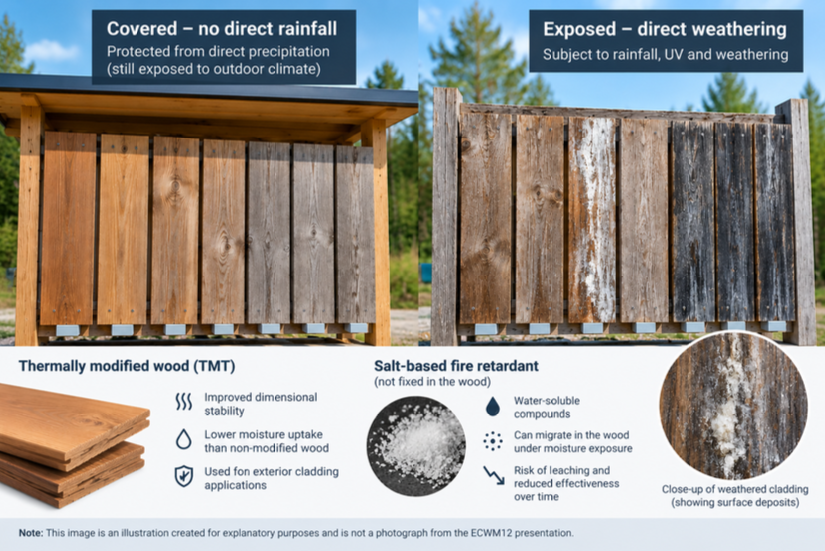
Illustrative image showing sheltered and exposed cladding. It is not a photograph of the ECWM12 experiments or presentation.
At the 12th European Conference on Wood Modification (ECWM12), Inge Wuijtsen of WOOD.BE, Belgium, presented research on the durability of fire-retardant treatments in thermally modified timber (TMT) cladding. The findings are particularly relevant to water-soluble, salt-based fire retardants that are not permanently fixed in the wood.
The research examined chemical redistribution and leaching after approximately three years of outdoor exposure. Two conditions were compared: covered cladding, sheltered from direct rainfall but still exposed to the outdoor climate, and exposed cladding, subject to direct weathering. Changes in chemical retention were observed even in the sheltered material.
This is noteworthy because TMT generally has lower moisture uptake than unmodified wood. Nevertheless, reduced moisture uptake does not eliminate the potential for migration of water-soluble treatment constituents.

The presentation reported Euroclass C for the sheltered configuration and Euroclass D for the directly exposed configuration. The initial classification, possibly intended to be Euroclass B, was not confirmed in the available summary. The speaker also cautioned that limited baseline testing and fire-test variability prevent a definitive causal attribution of the classification difference to leaching alone.
The central message: Initial fire classification does not by itself demonstrate durable fire performance throughout a product’s service life – even when treated cladding is protected from direct rainfall. Long-term retention and performance under actual service conditions deserve careful evaluation.
Source: Inge Wuijtsen, WOOD.BE, presentation at ECWM12, Dresden, 27 October 2026. This article summarises reported observations; it does not claim that all salt-based fire retardants behave identically